Apps built with AI in your Microsoft tenant: cost, limits and governance decisions
Anyone in your organisation can now build an app with AI and publish it into Microsoft 365. Before this is opened up, the organisation decides on data, access, spend and ownership.
For 50 people who use an internal app now and then, running it can cost around EUR 940 a year in Microsoft credits, against EUR 10,380 a year in Power Apps Premium licences. Since September 2026, anyone in your organisation can build an app with AI and publish it into your own Microsoft 365 tenant. Before that, someone has to decide which data the app uses, who has access to it, who pays for it and who is responsible for it after go-live.
What changed
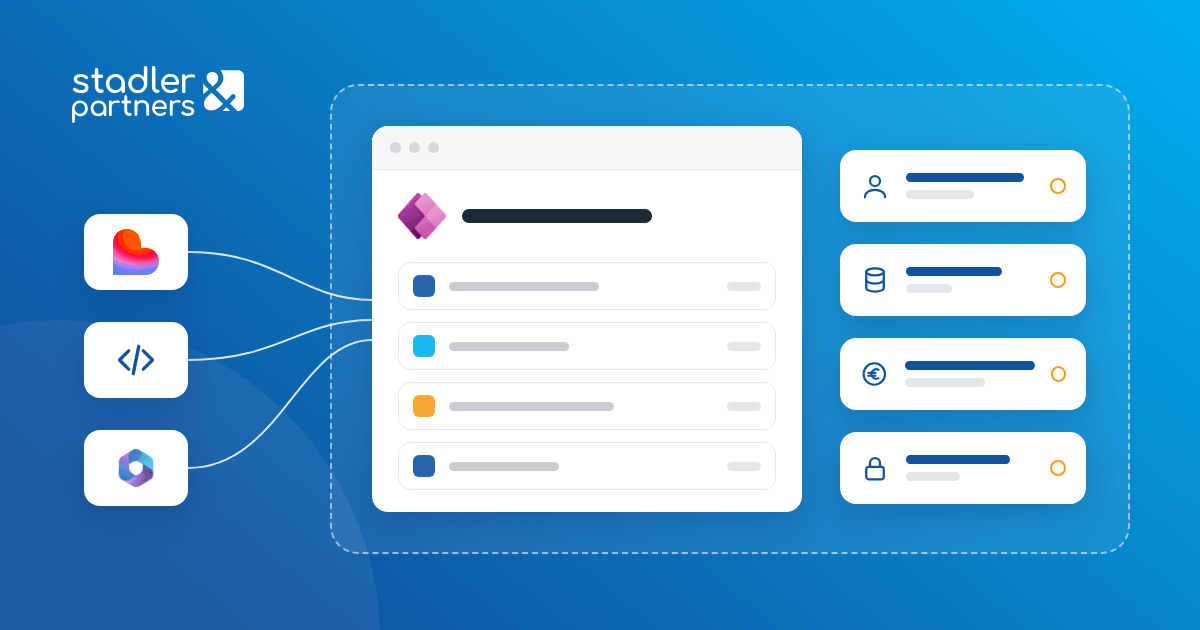
Since autumn 2026 Microsoft has Copilot Managed Runtime in public preview: a host inside your tenant for web apps built with AI, whether in the browser with Lovable, with a coding assistant such as Claude Code or GitHub Copilot, or in Copilot itself.
According to Microsoft’s documentation, every app gets:
- sign-in with work accounts through Microsoft Entra ID;
- tenant policy from the moment it is created: Conditional Access, data policies, sharing limits, content security;
- an entry in a central inventory in the Microsoft 365 admin center, with owner, usage and health.
Apps are internal only. There is no public or anonymous access.
What it costs to run
Each user needs one of two things. Microsoft list prices, excluding VAT:
- Power Apps Premium: EUR 17.30 per user per month, the price Microsoft shows today.
- Copilot Credits, pay as you go: each app launch and each read or write through a connector costs 0.1 credits, about USD 0.001.
Power Apps use rights included with Microsoft 365 or Dynamics 365 do not cover these apps.
The example above assumes 50 users, 3 sessions a day of about 30 operations each, over 20 working days: roughly 90,000 operations, or about EUR 78 a month in credits. A licence only becomes cheaper for a user who runs more than about 20,000 operations a month. The usage figures are our assumption; the real figure is measured after a month of use.
Limits of each option
Lovable, published into Microsoft 365. Business users build in the browser. Limits: source code and chat history stay in Lovable; only the built artifact is published to your tenant. Lovable’s own databases, backend functions and secrets are not part of the published app. Publishing is tied to the identity of whoever owns the Lovable connection. The integration requires a Lovable Business or Enterprise plan.
A coding assistant, published to the same host. The code is yours, in a Git repository. Limits: the app is created in its maker’s personal environment, and Microsoft’s preview documentation does not yet describe a path from test to production of the kind Power Platform solutions have.
Power Apps code apps. The same web stack, but the app is packaged in a Power Platform solution and deployed to development, test and production environments with pipelines, connection references and environment variables. Limits: it needs a developer who knows Dataverse, and a Premium licence per user.
Model-driven Power Apps. Forms, views and processes generated from Dataverse, configured rather than coded. Limits: the interface is what the platform provides.
What stays with you
The tools build and host the app. The decisions below remain with the organisation. Before app building is opened up in your tenant, someone has to own these answers:
- Who may create apps. Creation from the command line is off by default; creation from Copilot Studio is on.
- Which environment apps are created in. Each new app is created in its maker’s personal environment, which starts without Dataverse. Per Microsoft’s documentation, the routing rule created for these apps is permanent, and the catch-all rule for everyone cannot be changed once the first app exists. This is decided once, up front.
- Which connectors and data apps can access. The default policy allows 18 Microsoft connectors that authenticate only through Entra ID and blocks open-ended actions such as arbitrary HTTP requests. Anything beyond that is a decision.
- Who pays. Without a spending policy, unlicensed users are blocked after 20 operations or five minutes. With one, consumption needs watching, and build costs and run costs are managed in different admin centers.
- Who owns each app, and when it is reviewed. Deleting a project in Lovable does not delete a published app. Revoking someone’s access to an app does not revoke their access to the data behind it; those are separate operations.
- When an app is promoted to a managed setup. A team tool can stay where it is. For an app a business process depends on, the data is migrated to Dataverse and the app is tested before production.
These are governance decisions; their technical consequences appear in the app inventory, in licensing and in data access months after the first apps are published.
Documented versus tested
Everything here about Managed Runtime comes from Microsoft’s documentation and from Lovable’s announcement. We have not yet run Managed Runtime in production at a client. Microsoft describes the platform as preview and subject to change. What we say about environments, solutions and Dataverse comes from our own Power Platform delivery.
The order of questions
- Will anyone outside the organisation use it? If so, Managed Runtime is out: it has no external access.
- Does a business process depend on it, and must it be tested before production? If so, the data is stored in Dataverse and the app is deployed through separate environments, as a code app or a model-driven app.
- How many people use it, and how often? For an occasional internal tool, credits are cheaper than licences. For heavy daily use, the licence.
Make the six decisions above before app building is opened up in the tenant, so that each app has an owner and rules from the start.
Sources
- Microsoft Learn: Copilot Managed Runtime licensing FAQ (preview)
- Microsoft Learn: Copilot Managed Runtime default governance settings (preview)
- Microsoft Learn: Copilot Managed Runtime overview for admins (preview)
- Microsoft Learn: Publish a Lovable app to Copilot Managed Runtime
- Microsoft Learn: Power Apps code apps, ALM
- Lovable: Run apps in your own Microsoft tenant
About us
We have done SharePoint governance since 2010, three and a half years of it inside a European Union agency, and we have worked on Dataverse since it was Dynamics CRM, in 2007. Everything runs in your own Microsoft 365 and Azure, with no separate platform to license or maintain. If you want these decisions written down before app building opens up in your tenant, get in touch.
Denis Stadler
Founder of Stadler & Partners. AI specialist and Agentic AI solution architect on Azure, Azure DevOps, SharePoint, Dynamics 365 and Power Apps. Writes about Microsoft 365 features as they work in production.
About Denis